
Quick Answer: Winter lawn care isn’t about active maintenance, it’s about damage control. Stay off frozen or waterlogged grass, keep de-icing salt off turf edges, and only water dormant grass during extended dry spells with no snow cover. Skip fertilizer and weed treatments until the ground thaws. The real risks aren’t cosmetic. Turf scientists track four distinct ways lawns die over winter, and most homeowner guides only mention one of them.
Most winter lawn care advice reads like a fall to-do list stretched into December. Rake the leaves, winterize the mower, then coast until spring. That’s fall prep, and it matters, but it’s a different job from what your lawn needs once the ground freezes. Turf researchers who study golf courses and sports fields for a living track something homeowners rarely hear about: turf doesn’t just “go dormant” and wait out winter safely. It can die from several distinct causes, and knowing which one you’re risking changes what you should do about it.
What’s Happening to Your Lawn During Winter Dormancy

Dormant doesn’t mean inert. Penn State Extension’s turfgrass program identifies four separate causes of winterkill in the northern United States: desiccation (drying out from wind exposure with no snow cover), direct low-temperature kill (a sudden hard freeze after a warm spell that catches the plant before it’s cold-hardened), ice encasement (oxygen depletion under a thick, long-lasting ice sheet), and crown hydration (thawed water refreezing inside the plant’s crown tissue). Michigan State University’s Kevin Frank adds one more factor to the mix: snow mold, a fungal disease rather than a physical one.
Here’s the detail almost no homeowner guide mentions: your grass species determines which of these risks applies to you. MSU’s research ranks perennial ryegrass as having poor low-temperature hardiness, compared to good hardiness for Kentucky bluegrass. If you overseeded with ryegrass this fall, per our winter grass seed guide, that’s specifically the risk worth paying attention to, not desiccation or ice.
Stay Off Frozen or Waterlogged Grass
Frozen grass blades are brittle, and walking on them physically breaks the cell walls, leaving damage that won’t green up in spring. The bigger risk is what’s happening underneath: crown hydration injury, the same mechanism Penn State and MSU both flag as a leading winterkill cause, gets worse when soil in low or poorly drained spots stays saturated and then refreezes. Foot traffic compacts that already-vulnerable ground further.
The practical rule is simple. If it crunches or squishes underfoot, stay off it. Set foot paths, sled runs, and dog routes somewhere else until it firms up and dries.
The Salt and De-Icer Damage Most Winter Guides Skip
Rock salt spread on your driveway doesn’t stay on your driveway. University of Minnesota Extension puts a real number on how little it takes to matter: one teaspoon of salt is enough to pollute five gallons of water, and the sodium in common rock salt causes root dehydration, yellowing, and death in most turfgrass species along the edges where runoff collects.
Not all grass handles it the same way. UMN’s turf research found fine fescue tolerates high-salinity conditions better than almost any other species, while Kentucky bluegrass performs poorly along salted roadsides. If your lawn edge borders a heavily salted walkway, that’s worth knowing before you reseed a damaged strip in spring.
A few things reduce the damage: shovel and sweep before the ice has a chance to bond to pavement, since less ice means less salt needed. Use calcium chloride or a similar alternative instead of straight sodium chloride near turf. And apply sparingly, UMN’s own guidance is that a coffee mug’s worth of salt, about 12 ounces, covers roughly 1,000 square feet, which is more than most people think.
Do You Need to Water Your Lawn in Winter?
Only during extended dry spells with little to no snow cover, and only when temperatures allow water to soak in rather than freeze on the surface. Dormant grass needs far less moisture than actively growing grass, but its roots don’t stop working entirely, and a winter with unusually low snowfall removes the insulating, moisture-retaining layer that normally protects them.
UMN’s turfgrass researchers frame the risk with a specific rule of thumb: watch for desiccation when air temperatures run more than 20 degrees warmer than soil temperatures, since that gap means the plant is losing moisture to dry air faster than frozen soil can resupply it. That’s a real, checkable number, not a vague “water if it seems dry” guess. For the full breakdown of how often and how much, our guide to watering your lawn in winter covers the specifics by climate.
Snow Mold: The Disease That Shows Up After the Snow Leaves
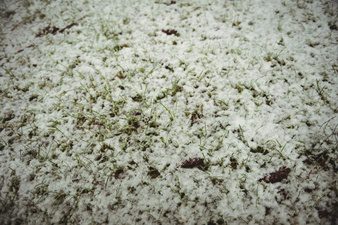
You won’t see snow mold while it’s happening. It develops under snow cover and only becomes visible once the melt exposes matted, discolored patches, gray or pink, depending on which fungus caused it. MSU’s Kevin Frank distinguishes the two: gray snow mold (Typhula blight) needs extended snow cover to develop, while pink snow mold can show up with or without snow on the ground at all.
Neither one is usually fatal to an established lawn. A light raking to fluff the matted grass and improve airflow once it’s dry enough to work is typically enough for cosmetic recovery. Cutting the grass a little shorter on your last fall mow, so it isn’t going into winter long and prone to matting, is the more useful prevention step, and it’s one more reason the final cut matters more than people assume.
What to Put on Your Lawn in Winter (and What to Skip)
Nothing, in most cases, once the ground is frozen. Fertilizer applied to frozen or dormant turf doesn’t get absorbed. It either runs off with the next thaw or sits on the surface doing nothing useful, and applying it wastes the product at best and contributes to nutrient runoff at worst. The same logic applies to weed treatments: herbicides need active plant growth to work, and most winter weeds are either dormant or growing too slowly for a treatment to take effect.
The one exception is a properly timed fall feeding applied before the ground froze, which is a fall-prep task, not a winter one. If you’re not sure whether you got that window closed out, our guide to winterizing your lawn covers the full fall checklist, and our guide to what actually happens to weeds in winter explains why some of what looks dead in your beds absolutely isn’t.
Common Winter Lawn Care Mistakes
Treating winter like a maintenance-free season is the biggest one. The task list is just narrower and different from fall’s, and skipping all of it because “the grass isn’t growing anyway” is how salt damage and desiccation go unnoticed until March.
Piling shoveled snow in the same spot near the lawn edge every time is a quieter mistake. Heavy, repeated snow accumulation compacts the soil underneath and can smother the grass longer than the surrounding lawn, since it takes weeks longer to melt. Rotate where you pile it if you can.
And removing every trace of ice from the lawn the moment you see it isn’t necessary either. Penn State’s turf program notes that even on ice-sensitive species like perennial ryegrass, removal only becomes worth the trouble once a sheet has sat for 30 to 45 days, the point where oxygen depletion underneath becomes the real threat. Hardier Kentucky bluegrass tolerates ice cover even longer. A thin glaze after one storm doesn’t come close to either threshold, so breaking it up just adds soil disturbance for no real benefit.
DIY or Hire a Pro for Winter Lawn Care?
Most of what matters in winter, staying off frozen grass, watching salt use, checking for dry spells, is homeowner-level and doesn’t require a crew. Where professional help earns its cost is snow and ice management itself: consistent, careful plowing and shoveling that doesn’t pile snow against the same turf edge all winter, and de-icing done with the lawn in mind rather than just the pavement.
If you’d rather not be the one deciding how much salt is too much at 6 a.m. before work, LawnGuru connects you with local snow removal pros who can handle your driveway and walkways without turning your lawn edge into next spring’s dead zone.
FAQ
Is it better to leave grass long or cut it short for winter?
Shorter, within reason. A final mow around 2 to 2.5 inches for cool-season grass reduces matting under snow, which is one of the conditions that lets snow mold take hold. Scalping the lawn is its own mistake, so aim for a gradual reduction over the last few cuts rather than one drastic drop.
What month should you apply winterizer to your lawn?
Before the ground freezes, not during winter itself, typically the last few weeks of active fall growth depending on your region. Once soil temperatures drop and the lawn goes dormant, a winterizing fertilizer application is too late to help and may just wash away.
Can grass die from being walked on in winter?
Yes, especially when it’s frozen or the ground underneath is saturated. Frozen blades snap under pressure, and repeated traffic on wet, cold soil compacts it and can crush the crown tissue the plant regrows from in spring.
Does snow protect grass or hurt it?
Mostly protect. A layer of snow insulates the crown from extreme temperature swings and actually reduces desiccation risk. The exception is when it lingers for months in one compacted pile or forms a thick ice layer underneath, which can trap the plant without oxygen.