St. Augustine grass covers more warm-climate lawns in the American South than any other species. Drive through suburban Florida, Texas, or the Gulf Coast and you are almost certainly looking at it. But a lot of homeowners who grow it every day could not tell you its scientific name, why it spreads the way it does, or what is actually causing those yellow patches spreading across the lawn in summer.
This guide covers everything: how to identify it, where it thrives, which variety fits your situation, how to plant it, what kills it, and how to figure out why yours is turning yellow.
Quick Answer: St. Augustine grass (Stenotaphrum secundatum) is a warm-season turfgrass that grows in USDA hardiness zones 8-10, primarily across Florida, Texas, and the Gulf Coast. It has wide, flat, rounded blades and spreads by above-ground runners called stolons. It cannot be grown from seed; you plant it using sod or plugs. Common varieties include Floratam, Palmetto, Raleigh, and Captiva. The most frequent maintenance problems are iron deficiency and chinch bug damage, both of which cause yellowing. A pallet of St. Augustine sod covers 400-500 sq ft and typically costs $200-$500 depending on variety and region.
What Does St. Augustine Grass Look Like?
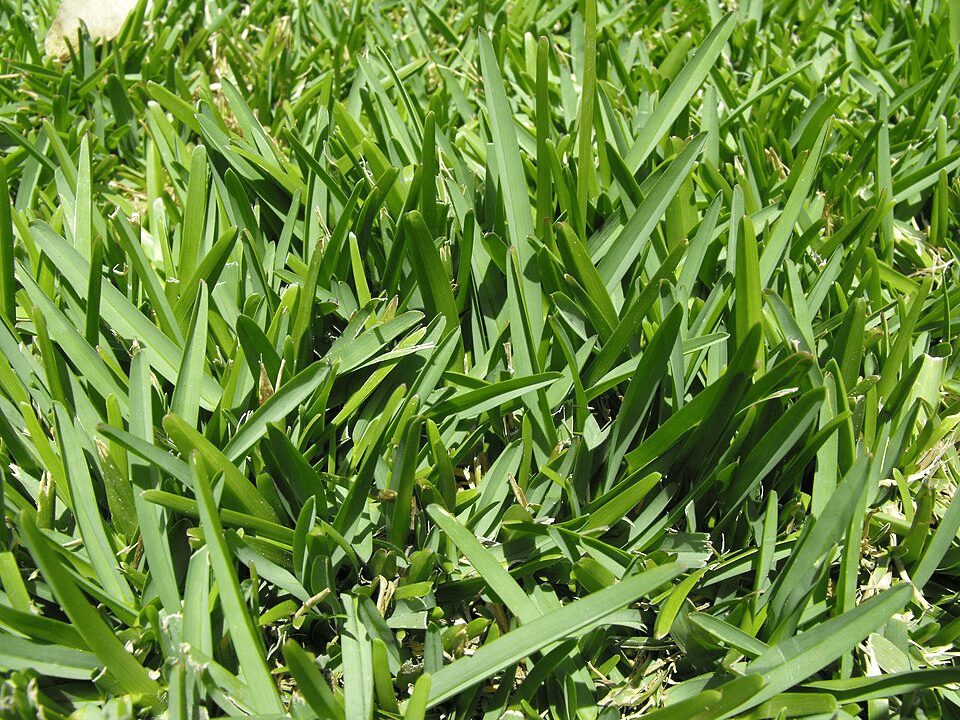
St. Augustine grass is easy to recognize once you know what to look for. The leaf blades are wide and flat (4-8 mm across), with a distinctly rounded tip rather than the pointed tip you see on bermuda or zoysia. The blades are medium to dark green and feel coarse to the touch. The grass grows in a dense, mat-like pattern, spreading outward from thick, fleshy stems that run above the soil surface.
Those above-ground stems are called stolons, and they are the most distinctive feature of the species. Stolons look like thick, flat runners crawling across the soil surface, rooting into the ground at regular intervals and sending up new leaf shoots as they go. If you pull up a section of St. Augustine sod, you will see these horizontal stems clearly.
Per NC State Extension’s turfgrass factsheet, St. Augustinegrass (Stenotaphrum secundatum) has a distinctly compressed sheath and a membranous ligule at the base of the blade, features that distinguish it from similar warm-season species under close inspection.
Where Does St. Augustine Grass Grow Best?
St. Augustine grass is adapted to warm, humid subtropical climates. It performs best in USDA hardiness zones 8-10, which covers most of Florida, the Gulf Coast states (Louisiana, Mississippi, Alabama), coastal Georgia, South Carolina, and the southern half of Texas. It is also grown in parts of California, Hawaii, and tropical regions worldwide.
It handles heat well but is sensitive to cold. Sustained temperatures below 55°F slow its growth, and freezing temperatures can kill the stolons in colder zones. It goes dormant in mild frost conditions and recovers when temperatures rise in spring, but extended hard freezes in zone 7 or below cause significant dieback.
St. Augustine has better shade tolerance than any other warm-season grass, which is part of why it dominates in regions with large trees. It performs well with as little as 4-6 hours of direct sunlight per day, where bermudagrass would thin out entirely.
University of Florida IFAS notes that St. Augustinegrass is widely adapted to warm, humid subtropical regions but performs best when soil pH is kept between 6.0 and 7.5. A soil test every 2-3 years is the most reliable way to confirm you are in that range.
St. Augustine Grass Varieties: Which One to Choose
Several cultivated varieties (cultivars) of St. Augustine grass are available, and they differ meaningfully in shade tolerance, cold hardiness, texture, and pest resistance.
| Variety | Key Strengths | Shade Tolerance | Cold Hardiness | Notes |
|---|---|---|---|---|
| Floratam | Widest availability; vigorous; fast-spreading | Low | Moderate | Most popular in FL and TX; coarser texture |
| Palmetto | Semi-dwarf; best all-around shade tolerance | High | Better than Floratam | Stays greener longer into fall; premium price |
| Raleigh | Best cold hardiness for SAG | Moderate-High | Best in class | Good choice for zone 7b-8 border areas |
| Seville | Fine texture; semi-dwarf | High | Lower | Less cold-hardy; popular in south FL |
| Captiva | Chinch bug resistance; semi-dwarf | Moderate | Moderate | Bred for Florida; lower mowing requirement |
| Bitter Blue | Darker color; slower growth | High | Moderate | Older variety; still preferred in some markets |
Floratam is the default choice in most nurseries and sod farms, but it performs poorly in shade. If your lawn has tree cover, Palmetto or Raleigh are worth the additional cost. If chinch bugs have been a recurring problem, Captiva is the most effective long-term solution.
Does St. Augustine Grass Spread on Its Own?
Yes. St. Augustine grass spreads naturally by extending its stolons outward from established areas. During peak growing season (late spring through summer), a healthy lawn can extend stolons 1-4 inches per week. When a stolon reaches bare soil, it takes root and establishes a new growth point.
This spreading behavior is what makes plugs a viable establishment method. You plant small plugs of established grass 6-12 inches apart across a prepared bed, and the stolons fill in the gaps over 6-12 months, depending on plug spacing and growing conditions.
The spread rate depends on three factors: soil nitrogen levels (higher nitrogen means faster horizontal growth), consistent watering, and mowing height. Mowing too low stresses the stolons and slows lateral spread. Keeping the lawn at 3-4 inches allows the stolons to focus energy on horizontal expansion. Thin or bare areas in an existing lawn will fill in naturally from surrounding grass if the underlying cause (compaction, shade, pest damage) is corrected.
Sod vs. Plugs: The Only Two Ways to Plant St. Augustine Grass
St. Augustine grass cannot be grown from seed commercially. The seeds it does produce are rarely viable under cultivation conditions, and no commercially available seed exists for the commonly grown varieties. Every St. Augustine lawn starts with either sod or plugs.
Sod gives you an instant lawn. A pallet of sod is laid edge-to-edge across prepared soil, and the lawn is functional within 2-3 weeks as roots knit into the soil below. The trade-off is cost and weight, as pallets are heavy and delivery adds to the expense.
Plugs are 2-4 inch squares or cylinders of established sod, planted at intervals across bare soil. They cost significantly less than full sod installation and work well for filling in bare patches or establishing a new lawn on a budget. The trade-off is time: a plug-planted lawn takes 6-12 months to achieve full coverage.
The best planting window for both methods is late spring through early summer, when soil temperatures are consistently at or above 65°F and daytime highs are between 80°F and 100°F. Planting at least 90 days before your region’s first fall frost gives roots time to establish before dormancy. In Florida and South Texas, that window spans April through July. In more northern zones 8 areas (coastal Georgia, the Carolinas), plant from May through June to stay safely within the window.
Soil preparation before planting matters. Remove existing weeds and dead grass, loosen the top 2-3 inches of soil, and grade for drainage. Flat or low spots hold water, which invites fungal disease in St. Augustine.
How to Plant St. Augustine Grass Plugs (Step-by-Step)
Plugs are the most common choice for patching thin areas or establishing a new lawn at lower cost. Per Texas A&M AgriLife Extension’s St. Augustinegrass management guide, the process is straightforward when done at the right soil temperature.
- Water the area thoroughly the day before planting. Moist soil makes digging plug holes easier and gives roots immediate moisture on contact.
- Dig holes 3-4 inches deep and 2-4 inches wide at your chosen spacing. Closer spacing (6 inches) fills in faster; wider spacing (12 inches) reduces cost but adds 3-4 months to full coverage.
- Plant plugs in a diamond (offset) pattern rather than straight rows. Offset rows mean the stolons growing from one plug fill gaps between adjacent plugs more efficiently.
- Press each plug firmly into its hole so the crown sits at or just above soil level. Plugs planted too deep rot; plugs planted too high dry out before rooting.
- Water immediately and keep the soil moist for the first 7-14 days. Short, frequent watering sessions (10-15 minutes twice daily) keep the top 2-3 inches moist without washing plugs out of position.
- Transition to deeper, less frequent watering once plugs have visibly sent out new leaf growth (usually 10-14 days). This signals the roots have established contact with the surrounding soil.
Once new growth is visible, do not mow for at least 30 days. The first mow should remove no more than one-third of the blade height.
How to Maintain a St. Augustine Grass Lawn
St. Augustine requires consistent maintenance to stay dense and healthy. Neglect opens the door to chinch bugs, brown patch fungus, and weed invasion through the thatch layer.
Mowing: Mow at 3-4 inches for sun-exposed areas; shade-grown St. Augustine performs better at 3.5-4 inches since additional blade area compensates for lower light. Mow every 5-7 days during the summer growing season. Never remove more than one-third of the blade in a single mow. St. Augustine’s thick blades can dull mower blades faster than finer-textured grasses; check blade sharpness every 20-25 hours of use. For a full mowing height reference across grass types and seasons, the lawn mowing heights by grass type and season guide covers the complete breakdown.
Watering: Established St. Augustine needs 3/4 to 1 inch of water per week during the growing season, applied in two sessions rather than daily light watering. Deep, infrequent irrigation develops a deeper root system; daily shallow watering keeps roots near the surface and increases vulnerability to drought stress. Signs the lawn needs water: blades fold lengthwise or take on a blue-gray color rather than bright green. For watering schedules by sprinkler type and lawn size, how often and how long to water your lawn has the specifics. Do not overwater. Consistently wet soil causes take-all root rot, St. Augustine’s most damaging fungal disease.
Fertilizing: St. Augustine needs 1-4 lbs of nitrogen per 1,000 sq ft per year. Begin the first application once the lawn has fully greened up in spring (April-May in most zones), using a slow-release fertilizer. Follow up every 6-8 weeks through the growing season, stopping 6-8 weeks before the expected first frost date to avoid pushing tender growth that frost will kill. St. Augustine responds well to iron, especially in high-pH soils where iron becomes less available to the roots.
Herbicides: Use caution with weed control products. St. Augustine is sensitive to atrazine (use only at label rates), and some broadleaf herbicides containing 2,4-D can damage it at high rates. Always verify the product label includes St. Augustinegrass before applying.
Why Is My St. Augustine Grass Turning Yellow?
Yellow patches in St. Augustine are one of the most common problems homeowners report. The cause matters because each one requires a different fix.
Iron deficiency is the most common cause of yellow-green or lime-colored St. Augustine in Florida and Texas. It is not actually a lack of iron in the soil; it is usually a pH problem. When soil pH rises above 7.0, iron becomes chemically unavailable to grass roots even when iron is present in the soil. The fix is not adding more iron, it is lowering the pH with sulfur applications or applying chelated iron directly to the foliage. When to apply iron to your lawn covers the product types and timing in detail.
Chinch bugs cause yellowing that starts in sunny, dry areas of the lawn and spreads outward in an irregular pattern. The damage looks like drought stress but does not respond to watering. To confirm chinch bugs, push a bottomless coffee can into the turf at the edge of the yellowing zone, fill it with water, and watch for the small black-and-white insects floating to the surface within 5 minutes. How to spot and stop chinch bugs covers identification and treatment for this specific St. Augustine pest.
Overwatering and poor drainage cause yellowing that tends to follow low spots or areas with compacted soil where water pools. The grass blades turn pale yellow-green and feel soft. Pull back a section of sod and look at the roots; healthy roots are white, while overwatered roots are dark brown and smell of rot.
Cold stress and dormancy cause the entire lawn to turn yellow-brown in winter. This is normal. St. Augustine goes dormant when soil temperatures drop below 55°F. It is not dead. It will green up again when soil temperatures rise in spring.
Nitrogen deficiency shows as a pale, uniform yellowing across the entire lawn rather than patches. If the color change is gradual and widespread, a fertilizer application is usually the fix. A soil test removes the guesswork.
How Much Does a Pallet of St. Augustine Sod Cost?
A pallet of St. Augustine sod covers 400-500 sq ft, depending on the sod farm’s cutting thickness and tray size. Pricing varies significantly by variety, region, and availability.
| Variety | Avg. Cost per Pallet (sod only) | Notes |
|---|---|---|
| Floratam | $180-$350 | Most widely available; lowest cost |
| Palmetto | $250-$475 | Premium; semi-dwarf varieties cost more |
| Raleigh | $200-$400 | Harder to find outside Southeast |
| Captiva | $280-$500 | Specialty variety; limited availability |
These are material-only costs. Professional installation adds $1-$2 per square foot for labor, site preparation, and disposal of existing turf. A 1,000 sq ft installation typically runs $1,800-$3,500 installed, depending on site conditions and your location in the Southeast or Gulf Coast.
Buying directly from a sod farm rather than a garden center or big-box retailer typically saves 20-30% on material cost, and the sod is fresher (less time sitting on pallets = better root establishment). Call local farms directly, as pricing is rarely listed online and fluctuates with demand.
Timing also affects cost. Spring and early summer are peak season; prices are highest from April through June when installation demand is highest. Fall installations often come at a small discount, though you lose some of the establishment window.
Common Questions About St. Augustine Grass
Is St. Augustine grass high maintenance?
It is moderate to high maintenance compared to lower-input alternatives like centipede or zoysia. It needs mowing every 5-7 days in summer, consistent fertilization, and careful pest monitoring for chinch bugs. The dense growth habit is its strength, but it also creates a thatch layer that needs annual dethatching or verticutting in mature lawns to maintain health.
What is the downside of St. Augustine grass?
Three downsides stand out. First, it has no viable commercial seed, so repairs and new installations always require sod or plugs. Second, it is susceptible to chinch bugs and take-all root rot in ways that bermudagrass is not. Third, it has limited drought tolerance compared to bermuda or buffalograss; it needs consistent irrigation to stay healthy rather than relying on dormancy to weather dry spells.
Is Zoysia or St. Augustine better?
They serve different goals. Zoysia uses less water and is more cold-hardy, making it a better choice in the transition zone (zones 6-7) and for water-restricted situations. St. Augustine is better in shade, establishes faster, and produces a denser, lush appearance with adequate water. For humid, warm climates with good rainfall or irrigation, St. Augustine typically wins on aesthetics. For lower-input situations or partial shade with low summer rainfall, Zoysia is the stronger choice.
Will coffee grounds help St. Augustine grass grow?
Coffee grounds lower soil pH slightly and add a small amount of nitrogen. On high-pH soils where iron availability is limited, this can have a modest benefit. In most cases, the effect is negligible compared to a targeted fertilizer or sulfur application. Coffee grounds are not a substitute for proper fertilization, and applying too much at once creates a dense mat that can interfere with water infiltration.
Can you put St. Augustine seed over existing grass?
Commercially viable St. Augustine seed does not exist for the varieties used in residential lawns. You cannot overseed St. Augustine the way you would bermuda or tall fescue. Bare spots must be filled with sod pieces or plugs taken from established sections of the lawn or purchased from a nursery. Clemson University’s maintenance calendar for St. Augustinegrass covers the plug repair process in detail, including timing by region.
The Bottom Line on St. Augustine Grass
St. Augustine grass is the best choice for warm, humid, partly shaded lawns in zones 8-10. It is dense, fast-spreading, and handles Southern heat better than most alternatives. The trade-off is that it requires consistent care: regular mowing, reliable irrigation, and enough attention to catch chinch bugs and iron deficiency early, before they turn a small problem into a large replanting project.
For care timing across the full growing season, the warm season grass care schedule covers monthly tasks for St. Augustine and the other warm-season species it shares the Southeast with.