Quick Answer: Most lawns need 1 to 4 fertilizer applications a year, and the honest answer depends on how thick and green you want the grass, not a fixed number every lawn should follow. A once-a-year fall feeding keeps a lawn alive and reasonably green. Four feedings, spaced through spring, early summer, and fall, gets you the dense, weed-resistant lawn most homeowners picture when they ask this question. Illinois Extension ties the exact number to lawn density goals, which is the clearest framework available.
If you’ve searched this question before, you’ve probably noticed the advice doesn’t agree with itself. One site says once or twice a year. Another says three to four. A third says up to six. None of them are wrong, exactly. They’re answering different questions while using the same words.
Why the Advice Ranges From Once a Year to Six Times
LawnStarter tells established lawns to fertilize once or twice a year. Weed Man and most AI-generated search summaries land on three to four. Grasshopper Gardens, a Capital District lawn care company, goes as high as six for homeowners chasing “premium” results. Scotts, unsurprisingly, recommends four applications of its own product line.
The number isn’t inconsistent because someone’s guessing. It moves because “how often” is shorthand for “how thick and green do you want this lawn, and how much are you willing to do to get there.” A once-a-year fall application keeps turf alive, reasonably green, and able to compete with weeds. It won’t get you the dense, uniform lawn a lawn care company photographs for its website. That takes three or four feedings timed to the grass’s growth cycle, not just one shot of nitrogen before winter.
Illinois Extension is the one source that names this trade-off directly instead of dancing around it, which is why its framework is the one worth following instead of picking a number out of a range.
How Many Times a Year, Based on the Lawn You Want
Illinois Extension’s fertilizing guidance ties frequency directly to the lawn density you’re aiming for, and splits the annual nitrogen total evenly across however many applications you choose:
| Lawn Goal | Applications/Year | When |
|---|---|---|
| Low density (fine, don’t mind some thin spots) | 1 | Late summer to early fall |
| Low to moderate density | 2 | Spring, then late summer to early fall |
| Moderate to high density | 3 | Spring, late summer to early fall, late season |
| High density (thick, uniform, weed-resistant) | 4 | Spring, early summer (irrigated lawns only), late summer to early fall, late season |
A lawn fertilized once a year isn’t a failing lawn. Illinois Extension’s own turf specialists point out that a single fall application, paired with good mowing and watering habits, can produce a perfectly acceptable lawn for people who aren’t chasing a golf-course look. The four-application schedule exists for homeowners who specifically want denser turf and are willing to spread the work across the growing season to get it.
Warm-season grasses like Bermuda and zoysia follow the same logic but shift the calendar: skip the fall and winter applications entirely, since these grasses go dormant and won’t use the nitrogen, and concentrate the same 1-to-4 tier structure between late spring and late summer instead.
When to Put Each Feeding Down
Cool-season grass (Kentucky bluegrass, fescue, ryegrass) does its heaviest growing in spring and fall, so that’s where the nitrogen should go:
- Spring: Early to mid-May in central regions, adjusted a few weeks earlier in the south of your state and later in the north. Wait until you’ve mowed two or three times before applying anything.
- Early summer (irrigated lawns only): Skip this one if you don’t water regularly during dry stretches. Feeding a lawn that can’t keep up with summer heat just stresses it further.
- Late summer to early fall: This is the single most important application of the year for cool-season grass, and the one to prioritize if you’re only doing one.
- Late season: Roughly a week after the final mow of the season. This is sometimes called a “winterizer” and it builds root reserves rather than pushing top growth.
Warm-season grass (Bermuda, zoysia, St. Augustine, centipede) runs on the opposite calendar: begin once the grass has fully greened up in late spring, continue every 6 to 8 weeks through summer, and stop by early fall before dormancy sets in. Fertilizing warm-season grass in late fall or winter wastes the product entirely, since dormant turf isn’t taking up nutrients.
For a full month-by-month breakdown, our guide to when to fertilize your lawn covers the exact windows by region.
How Much Fertilizer to Put Down at Each Application
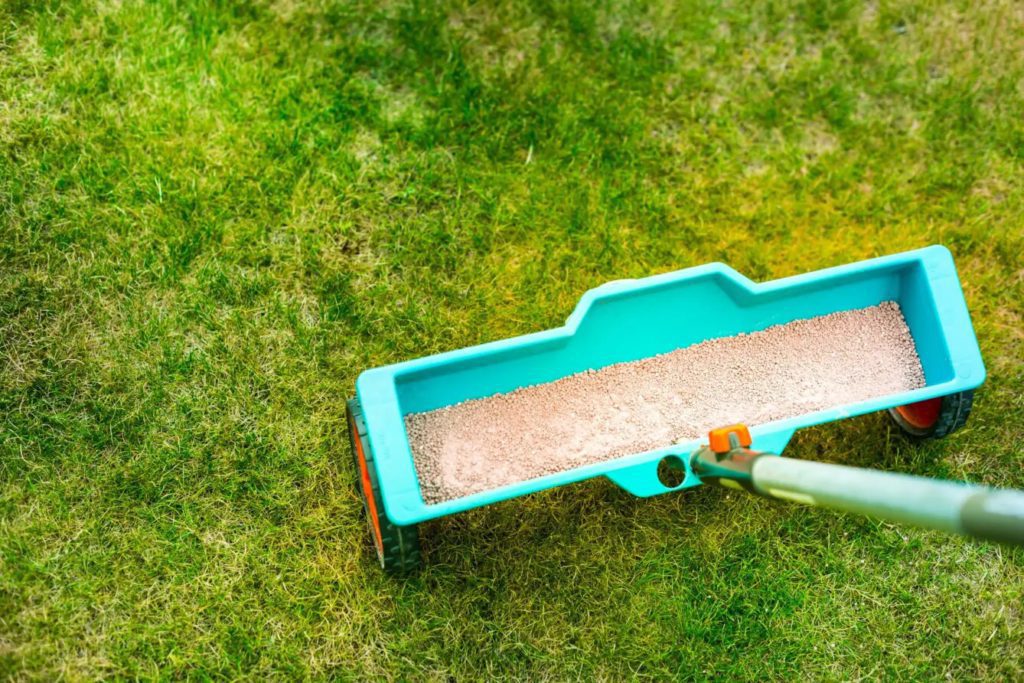
This is where a lot of advice gets vague or, worse, makes up specific numbers that aren’t tied to anything. The actual guidance from Illinois Extension: full-sun lawns need roughly 3 pounds of nitrogen per 1,000 square feet per growing season, split evenly across your chosen number of applications. Shaded lawns need about half that, since grass growing in less light can’t use nitrogen as efficiently. No single application should exceed 1 pound of quick-release nitrogen per 1,000 square feet, regardless of how many total feedings you’re doing.
Nitrogen is always the first number on a fertilizer bag. An 18-6-12 bag is 18% nitrogen by weight, which changes how much product you need to hit that 1-pound target. The math: divide the pound of nitrogen you want by the percentage on the bag (as a decimal), then multiply by your lawn’s square footage and divide by 1,000. For a 7,000-square-foot lawn using a 15-0-10 fertilizer, that’s 1 ÷ 0.15 = 6.7, times 7,000 = 46,900, divided by 1,000 = roughly 47 pounds of product to deliver 1 pound of actual nitrogen. Illinois Extension also recommends controlled-release nitrogen sources over fast-release urea for most home lawns, since they’re far less likely to burn grass and don’t dump all their nitrogen into a single growth flush.
If you haven’t tested your soil in the last three years, do that before buying anything. Illinois Extension’s soil testing guidance recommends sampling every three years for established lawns, and Penn State Extension notes that sandy soils should be tested slightly more often (every 2 to 3 years) than clay soils (3 to 4 years), since sandy soil loses nutrients faster. A soil test can also tell you whether your pH is blocking nutrient uptake in the first place; if it is, applying lime matters more than adding another round of fertilizer.
Spacing Your Applications Correctly
Don’t apply synthetic fertilizer more often than every 6 to 8 weeks. That interval isn’t arbitrary: it’s roughly how long it takes grass to use up a quick-release nitrogen application before it needs another one, and it’s also the buffer that keeps you under the “don’t exceed 1 pound of quick-release nitrogen per application” ceiling. Organic, slow-release products break down more gradually and can sometimes go 8 weeks or slightly longer between feedings.
If you’re on the 4-application schedule, that spacing works out naturally: spring, early summer, late summer/early fall, and late season land 6 to 10 weeks apart depending on your growing season length. Cramming applications closer together than that doesn’t make the lawn grow faster; it just increases the odds of fertilizer burn and nutrient runoff into storm drains.
Signs You’re Overdoing It (or Not Doing Enough)
Fertilizing every two weeks is a mistake almost everyone eventually asks about, and the answer is no. That interval delivers more nitrogen than the grass can use, which shows up as excessive growth that demands mowing twice a week, a dark, almost blue-green color that looks unnatural rather than healthy, and eventually fertilizer burn: brown, crispy patches where the salts in the product dehydrated the grass blades faster than they could absorb them.
Under-fertilizing looks different: pale or yellowing grass that doesn’t respond to watering, thin spots that let weeds establish, and slow recovery after foot traffic or dog damage. If the color problem is isolated yellowing rather than an overall pale lawn, iron deficiency is worth ruling out before assuming it’s nitrogen.
Compacted soil makes both problems worse, since fertilizer sitting on top of hard-packed dirt runs off instead of reaching the roots. If your lawn gets heavy foot traffic or hasn’t been aerated in the last year or two, pairing your next fertilizer application with core aeration gets nutrients into the root zone instead of washing away with the next rain.
Mistakes That Waste the Fertilizer You’re Putting Down
Two-in-one weed-and-feed products are a common shortcut that backfires. Crabgrass preventer needs to go down when soil hits 50-55°F, which is usually well before the lawn is ready for a full fertilizer application. Our guide to crabgrass preventer timing breaks down why combining the two jobs compromises both.
Timing fertilizer around mowing matters more than most people assume. Cutting the grass first helps fertilizer reach the soil instead of getting caught in the blades, but doing both on the same day raises the burn risk on freshly cut grass. Waiting 24 to 48 hours after mowing gives the lawn time to recover first.
Weather matters too. A light watering after fertilizing helps move nutrients into the soil, but a downpour within a few hours washes the product off the lawn before it’s absorbed, wasting money and sending nitrogen into storm drains instead of your grass. And a lawn that’s wilting from drought or already dormant for winter isn’t actively taking up nutrients in the first place, so fertilizing in either state doesn’t help and can make the underlying stress worse.
FAQ
Can I fertilize my lawn every 2 weeks?
No. Established lawns need 6 to 8 weeks between synthetic fertilizer applications. Feeding every two weeks delivers more nitrogen than the grass can use, leading to excessive growth, fertilizer burn, and higher disease susceptibility.
Is it better to fertilize before or after it rains?
A light rain or watering shortly after applying fertilizer helps move nutrients into the soil. Heavy rain forecast within a few hours of application should be avoided, since it can wash granular or liquid fertilizer off the lawn before the grass absorbs it.
Can I mow and fertilize on the same day?
It’s better not to. Mow first if the grass needs it, then wait 24 to 48 hours before fertilizing so the grass isn’t recovering from cutting stress and fertilizer stress at the same time.
What happens if I skip the fall application?
For cool-season grass, fall is the single most important feeding of the year, since it builds root reserves for winter and next spring’s green-up. Skipping it doesn’t kill the lawn, but it noticeably slows spring recovery compared to a lawn that got fed in September or October.