
Quick Answer: Pennsylvania spans USDA Plant Hardiness Zones 5a to 7b. The coldest ground is in the north-central mountains around Potter and McKean counties, zone 5a, where winter lows can hit negative 20°F. The warmest is the far southeastern corner near Philadelphia, zone 7b, where lows rarely drop below 5°F. Pittsburgh sits in zone 6b, and the Lake Erie shoreline runs slightly milder than the rest of the northwest thanks to the lake’s moderating effect.
A state with mountains, a Great Lake shoreline, and a river-valley metro area doesn’t have one climate, and Pennsylvania’s planting zones reflect that. The gap between the north-central highlands and Philadelphia is more than two full zones, wide enough that a shrub planted safely outdoors in one region needs winter protection or won’t survive at all in the other.
What a Planting Zone Measures
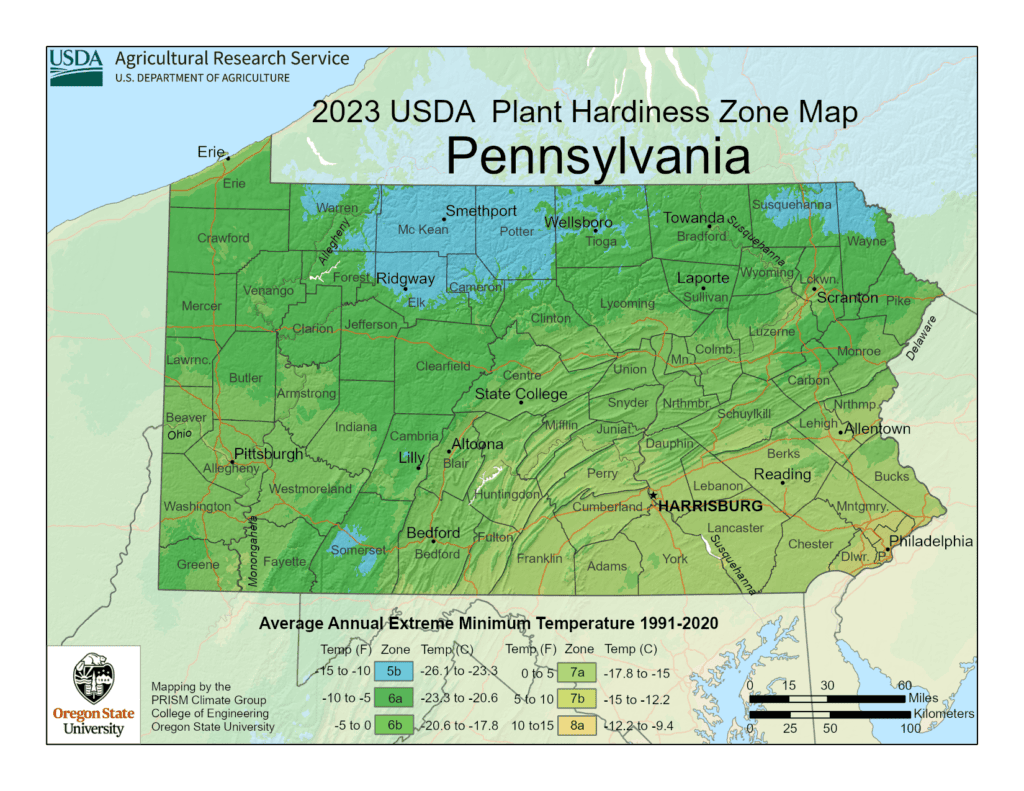
A USDA hardiness zone is built from a single number: the average coldest night a location sees over a 30-year stretch. It doesn’t account for summer heat, humidity, or soil type, only winter lows, which is exactly the information that determines whether a perennial, shrub, or tree survives the season. Each full zone spans 10 degrees, split into a colder “a” half and a warmer “b” half five degrees apart. Our general guide to USDA hardiness zones covers the full mechanics of how the map works if you want more background; this page focuses on where Pennsylvania specifically falls.
The USDA’s Agricultural Research Service updated the national map in 2023 using 1991 to 2020 climate data, the first revision since 2012. Most of Pennsylvania shifted about half a zone warmer as a result, consistent with a national trend. Penn State Extension notes that these zone boundaries also account for elevation, proximity to large bodies of water, and terrain position, not just latitude, which is part of why Pennsylvania’s map looks more like a patchwork than a clean set of horizontal bands.
Pennsylvania’s Planting Zones at a Glance
| Zone | Winter Low | Roughly Where |
|---|---|---|
| 5a | -20°F to -15°F | North-central mountains: Potter, McKean, Tioga counties |
| 5b | -15°F to -10°F | Higher elevations of the Allegheny Plateau and Poconos |
| 6a | -10°F to -5°F | Much of central and western Pennsylvania |
| 6b | -5°F to 0°F | Pittsburgh, Harrisburg, and the broader river valleys |
| 7a | 0°F to 5°F | Lower Susquehanna and Delaware valleys |
| 7b | 5°F to 10°F | Philadelphia and the immediate southeastern corner |
A few sources note an extremely small pocket right at the Delaware border edging into zone 8a, but that sliver is small enough that it isn’t a meaningful planning zone for most gardeners in the region, zone 7b is the practical answer for southeastern Pennsylvania.
The North-Central Mountains: Zones 5a and 5b
Potter, McKean, and Tioga counties, along with the higher elevations of the Allegheny Plateau, see Pennsylvania’s harshest winters. Zone 5a lows can reach negative 20°F, and the growing season here runs noticeably shorter than the rest of the state. Frost-sensitive perennials need real protection through winter, and gardeners in this band do best sticking to plants explicitly rated for zone 5 or colder.
The Lake Erie Shoreline: Zone 6a Moderated by the Lake
Erie sits further north than much of central Pennsylvania, but Lake Erie’s mass keeps the immediate shoreline from swinging as cold as inland areas at the same latitude, a lake-effect moderating pattern similar to what parts of the Great Lakes region see elsewhere. Move even a few miles inland from the lake, though, and that moderating effect fades quickly.
Central and Western Pennsylvania: Zones 6a to 6b
Pittsburgh, Harrisburg, and most of the state’s river valleys fall in this band, with Pittsburgh specifically in zone 6b following the 2023 map update. Winters here are colder than Philadelphia but milder than the north-central mountains, and this middle ground supports the widest plant selection in the state, everything from cold-hardy natives to some borderline zone 7 ornamentals with a favorable microclimate.
Southeastern Pennsylvania: Zones 7a to 7b
The Delaware and lower Susquehanna valleys run zone 7a, and Philadelphia itself and the immediate surrounding area reach 7b, Pennsylvania’s mildest zone. Winter lows here rarely drop below 5°F, which is warm enough that some marginally hardy ornamentals that need protection further north survive outdoors with minimal care in this corner of the state.
What Your Zone Changes About What You Plant
Zone matters most for anything meant to survive more than one winter: trees, shrubs, and perennials. It matters far less for annual vegetables, since tomatoes, peppers, and similar crops die back every season regardless of zone and are timed by local frost dates instead. A fig tree that overwinters outdoors with minimal protection in Philadelphia’s zone 7b would need to be wrapped or brought into a garage in the north-central mountains’ zone 5a.
Grass follows the perennial rule rather than the annual one, since a lawn is meant to persist year after year. If you’re timing a new lawn, our guide to when to plant grass seed in Pennsylvania covers seeding windows by season, which line up closely with the frost-date patterns that follow from these same zones.
Finding Your Exact Zone
County-level zones are a starting point, not a precise answer for a specific property. Elevation changes, valley cold pockets, and urban heat from pavement and buildings can shift an individual yard by half a zone in either direction from the county average. The USDA’s ZIP code lookup tool gives you the exact zone for your address in a few seconds, worth checking directly if you’re near a boundary or planting something expensive enough that a wrong guess matters.
FAQ
What planting zone is most of Pennsylvania in?
There isn’t a single dominant zone. Central and western Pennsylvania, including Pittsburgh and Harrisburg, mostly falls in zones 6a to 6b, while the southeastern corner around Philadelphia reaches 7a to 7b and the north-central mountains drop to 5a and 5b.
Is Pittsburgh zone 6a or 6b?
Zone 6b, following the USDA’s 2023 map update, which shifted Pittsburgh and much of the surrounding region a half-zone warmer than the previous 2012 map.
What is the coldest planting zone in Pennsylvania?
Zone 5a, found in the north-central mountains around Potter, McKean, and Tioga counties, where winter lows can reach negative 20°F.
Does Pennsylvania have a zone 8 area?
Not meaningfully. A couple of sources note an extremely small pocket near the Delaware border that edges into 8a, but zone 7b is the accurate, practical answer for the state’s warmest corner around Philadelphia.
Does my planting zone tell me when to plant vegetables?
No. Hardiness zone predicts whether a perennial or shrub survives winter where you live; it doesn’t set a vegetable planting calendar, which follows your local frost dates instead. Those dates shift somewhat within a single zone based on elevation and local geography.