
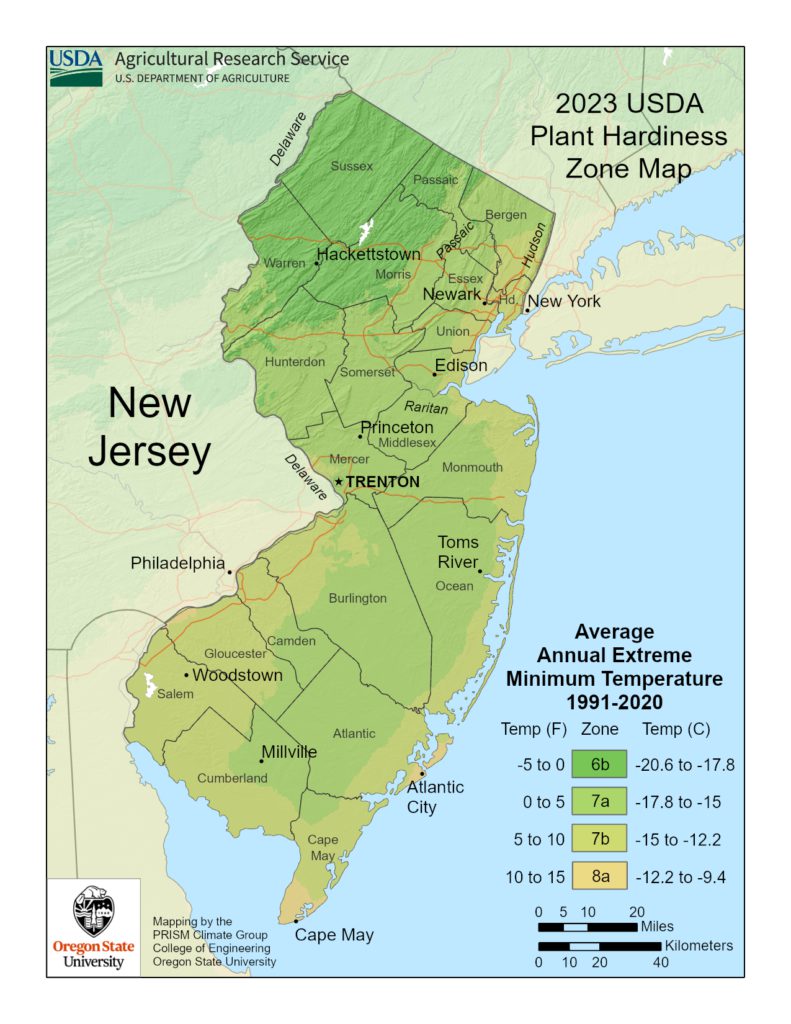
Quick Answer: New Jersey spans USDA Plant Hardiness Zones 6b to 8a. North Jersey, including Sussex and Warren counties, sits in zone 6b with winter lows down to negative 5°F. Central Jersey runs zones 7a to 7b. South Jersey and the coast, including Cape May, reach zone 8a, where winter lows rarely drop below 10°F. Four zones in a state this size is unusual, and it’s why a plant that thrives in Cape May can struggle sixty miles north in Sussex County.
Search “what planting zone is New Jersey” and most answers give you a single number, as if Newark and Cape May share a winter. They don’t. New Jersey runs about 170 miles top to bottom, and that distance plus the moderating effect of the coastline is enough to stretch the state across four separate half-zones. Knowing which one covers your yard changes what survives your winter and what doesn’t.
What a USDA Plant Hardiness Zone Tells You
A hardiness zone is based on one number: the average coldest night your area sees over a 30-year period. It says nothing about summer heat, rainfall, or soil, only how low winter typically gets. Each full zone spans 10 degrees, split into a colder “a” half and a warmer “b” half five degrees apart. Our general guide to USDA hardiness zones covers how the map works in more depth if you want the full mechanics; this page focuses on where New Jersey specifically falls.
The USDA’s Agricultural Research Service released an updated map in 2023 built on 1991 to 2020 climate data, the first update since 2012. Every part of New Jersey moved into a warmer zone as a result.
New Jersey’s Planting Zones at a Glance
| Zone | Winter Low | Roughly Where |
|---|---|---|
| 6b | -5°F to 0°F | Sussex, Warren, and northern Morris counties |
| 7a | 0°F to 5°F | Most of North and Central Jersey inland |
| 7b | 5°F to 10°F | Coastal Central Jersey, parts of South Jersey |
| 8a | 10°F to 15°F | Southern tip, including Cape May |
North Jersey: Zone 6b
The northwestern corner of the state, Sussex, Warren, and the higher elevations of Morris County, gets the coldest winters New Jersey sees. According to the New Jersey Conservation Foundation, Sussex County moved from zone 6a to 6b on the 2023 map, a shift reflecting an average low temperature about four degrees warmer than the 2012 map showed. That’s still cold enough that frost-sensitive perennials need real winter protection, and the growing season here runs noticeably shorter than the rest of the state.
Central Jersey: Zones 7a to 7b
Most of the state’s population lives in this band, Mercer, Middlesex, and Somerset counties among them, running mostly zone 7a inland with a shift to 7b along the coast. Winters here are milder than North Jersey but still bring regular hard freezes. Princeton, for reference, sits squarely in zone 7a.
South Jersey and the Coast: Zones 7b to 8a
South Jersey runs mostly zone 7b, with the southern tip around Cape May reaching zone 8a. The New Jersey Conservation Foundation notes Cape May specifically moved from 7b to 8a on the updated map, a three-degree shift. That’s warm enough that gardeners there are now growing camellia, magnolia, and crape myrtle outdoors with less risk of losing them to a hard winter, plants that would need protection or wouldn’t survive at all further north in the state.
Why New Jersey’s Zones Keep Shifting Warmer
Every one of New Jersey’s four zones moved warmer between the 2012 and 2023 USDA maps, part of a national trend where roughly half the country shifted at least half a zone. The change isn’t just a mapping update. It reflects thirty-year average winter lows that are measurably higher than they used to be, and it comes with tradeoffs beyond “you can grow more now.” Warmer winters mean southern ornamentals survive further north, but they also threaten crops that need cold, including New Jersey’s Pine Barrens cranberry industry, the southernmost cranberry-growing region in the country, and put pressure on native species like the northern red oak, the state tree, which is adapted to cooler conditions than the state is now trending toward. A warmer zone also nudges your own maintenance calendar earlier; our guide to prepping your lawn for spring covers how to adjust timing as the last frost keeps arriving sooner.
What Your Zone Changes About What You Plant
Zone matters most for anything you expect to survive multiple winters: trees, shrubs, and perennials. It matters far less for annual vegetables like tomatoes and peppers, which die back every year regardless of zone and are timed instead by your local frost dates. A camellia planted as a permanent shrub in Cape May’s zone 8a would need to be treated as tender or brought indoors in Sussex County’s zone 6b.
Grass follows a similar logic to perennials rather than annuals, since lawns are meant to survive year after year. If you’re seeding or overseeding, our guide to the best grass seed for New Jersey breaks down which cool-season varieties handle the state’s zone range and heavier clay soils well, organized by region rather than a single statewide pick.
Microclimates Can Shift Your Actual Zone
The county-level map is a starting point, not a guarantee. A yard tucked against a south-facing wall, shielded from wind, can run a half-zone warmer than an open field a mile away, and a low spot where cold air pools on a still night can run colder than the official zone for the area. Proximity to the Atlantic matters too, which is part of why coastal Monmouth County can register slightly milder than inland Somerset County despite sitting at similar latitude.
None of this changes the state-level map, but it’s worth factoring in if a plant tag says your zone is borderline or if something that should survive keeps dying back in the same corner of the yard every winter.
Finding Your Exact Zone
The USDA’s ZIP code lookup tool gives you the precise zone for your address in a few seconds, and it’s worth checking directly if you’re near a zone boundary or planting something that won’t tolerate a mistake, like a tree you expect to keep for decades.
FAQ
What planting zone is most of New Jersey in?
Most of the state’s population centers, including the Central Jersey corridor around Mercer, Middlesex, and Somerset counties, fall in zone 7a, with a shift to 7b closer to the coast.
Is New Jersey zone 6 or 7?
Both, depending on where in the state you are. Northwestern New Jersey, including Sussex and Warren counties, is zone 6b. The rest of the state runs 7a through 8a.
Is New Jersey in zone 8?
Only the southern tip. Zone 8a in New Jersey is limited to the area around Cape May and a narrow stretch of the immediate coast, where the Atlantic’s moderating effect keeps winter lows higher than the rest of the state.
Has New Jersey’s planting zone changed recently?
Yes. The USDA’s 2023 map update shifted every part of New Jersey into a warmer half-zone compared to the 2012 map, with some areas like Cape May moving a full three degrees warmer on average winter lows.
Does my planting zone tell me when to plant vegetables?
No. Hardiness zone predicts whether a perennial survives winter where you live; it doesn’t set a vegetable planting calendar, which depends on your local last and first frost dates instead. Those dates vary somewhat within a zone based on local geography.