Mushrooms grow in your lawn because something underground is rotting and the weather finally gave the fungus eating it a reason to show itself. The fungus was there all along, threaded through the soil around an old root, a buried board, or a thick layer of thatch. A few days of rain or heavy watering, and it pushes up mushrooms overnight.
That’s usually good news for the soil and harmless to the grass. But not every lawn mushroom is a shrug. A few are poisonous enough to send a child or a dog to the emergency room, and one particular cluster at the base of a tree means the tree itself is in trouble. This guide covers why they show up, how to tell the common ones apart, and when they’re worth acting on.
Quick Answer: Lawn mushrooms are the fruiting bodies of fungi that feed on decaying organic matter in the soil, most often buried wood, old tree roots, or stumps. They appear after prolonged wet weather or overwatering, especially in shade, heavy thatch, or poorly drained spots. Most are harmless to grass, and University of California IPM notes most lawn fungi are beneficial. Remove them if children or pets use the yard, since some species are poisonous. They stop when conditions dry out and disappear for good once their food source rots away.
What Mushrooms in Your Lawn Are
A mushroom is only a small part of the organism. The main body of the fungus is the mycelium, a network of fine threads spread through the soil. The mushroom you see is the fruiting body, which exists to release spores and then collapses.
University of California IPM explains that most fungi in lawns are beneficial because they decompose organic matter and release nutrients the grass can use. That’s also why picking or mowing mushrooms doesn’t get rid of them: the mycelium underground keeps living.
Why Do I All of a Sudden Have Mushrooms in My Yard?
Because the weather changed, not because something new moved in. UC IPM notes that fungi generally survive in the soil for years and produce mushrooms only when conditions are favorable, such as after a stretch of wet weather. The same fungus can sit unseen all summer, then fruit across the lawn the morning after three days of rain.
Iowa State University Extension adds that many lawn mushrooms prefer cool, damp conditions, and that they stop appearing once the weather turns warmer and drier. That’s why mushroom season often peaks in late summer and fall in many regions.
Why Mushrooms Grow in Your Lawn: The Conditions Behind Them
Moisture and Overwatering
Water is the trigger. Rain does it on its own schedule, but overwatering keeps the soil damp enough for fungi to fruit week after week. UC IPM specifically ties lawn mushrooms to overirrigation and poor drainage. If mushrooms keep popping up between rains, check your sprinkler timer first.
Shade
Shaded lawn stays wet longer after rain or watering because the sun can’t dry it out. Mushrooms under big trees and along the north side of a house are common for this reason alone.
Buried Wood and Decaying Roots
This is the most common food source. Iowa State says mushrooms in the lawn usually indicate decaying stumps or roots in the soil, and UC IPM adds buried construction lumber to the list. Illinois Extension points to the same culprits: decaying tree roots and buried construction debris. New homes built on cleared lots often get years of mushrooms as the old roots rot. If a tree came out recently, the stump or its decaying roots are almost certainly feeding them; our guide to stump grinding cost covers what it takes to remove more of that wood.
Thatch
Thatch is the layer of dead stems and roots between the grass blades and the soil. A thick layer holds moisture and gives fungi something to eat. UC IPM suggests removing excess thatch to help. Our guide to what dethatching is explains how to check whether yours is too thick.
Poor Drainage and Compaction
Low spots and compacted soil hold water at the surface, which keeps fungi fruiting. UC IPM recommends aerating to improve water penetration. If your lawn puddles after every rain, the mushrooms are a symptom; see the signs your lawn has drainage problems.
New Sod
Fresh sod is a mushroom magnet. UC IPM explains that new sod needs frequent irrigation to establish, which creates ideal conditions for small brown or light-colored mushrooms such as Panaeolus foenisecii and Conocybe species. They don’t harm the new lawn and disappear once watering is cut back to a normal schedule.
When Mushrooms Grow in Your Lawn Near Trees, It’s Often a Good Sign
Mushrooms in a ring or scatter under a living oak or pine aren’t automatically bad news. UC IPM explains that some fungi form a partnership with tree roots, called mycorrhizae, that helps the tree absorb water and nutrients. Many mycorrhizal fungi of trees produce mushrooms, so they can appear in the lawn around their host. UC IPM notes that many landscape trees, particularly oaks, pines, and other conifers, grow poorly or not at all without these fungal partners.
If the tree looks healthy, mushrooms under it are usually just part of how it feeds.
Honey Mushrooms: The One Lawn Mushroom That Signals Trouble
There’s one important exception. Armillaria mellea, often called honey mushroom or honey fungus, produces clusters of honey-colored mushrooms in fall at the base of a tree, on a stump, or in the lawn where a tree once stood. UC IPM warns that this fungus attacks and kills several hundred kinds of trees and shrubs, and that the mushrooms usually don’t appear until the host tree is dead or in advanced decline.
If you see tight clusters of tan to honey-colored mushrooms growing right at the base of a living tree, have an arborist look at the tree. The mushrooms aren’t a lawn problem, but they may be your first visible sign of a tree that could fail.
Fairy Rings

When mushrooms come up in a circle or arc, often with a ring of darker green grass, you’re looking at a fairy ring. The Missouri Botanical Garden says about 50 species of fungi can form them, with common rings running 2 to 15 feet across. The fungus grows outward from a single point, and the green ring comes from nitrogen released as it breaks down organic matter.
Most fairy rings are cosmetic. In some, the fungal mat gets so dense it repels water, and the grass inside the ring turns brown. Missouri Botanical Garden notes another quirk: on previously wooded lots, several rings can appear close together, but they don’t cross, because the fungi stop growing where they meet. Fixes for damaging rings are covered in the removal section below.
Common Lawn Mushrooms and How to Recognize Them
| Mushroom | What It Looks Like | What It Tells You |
|---|---|---|
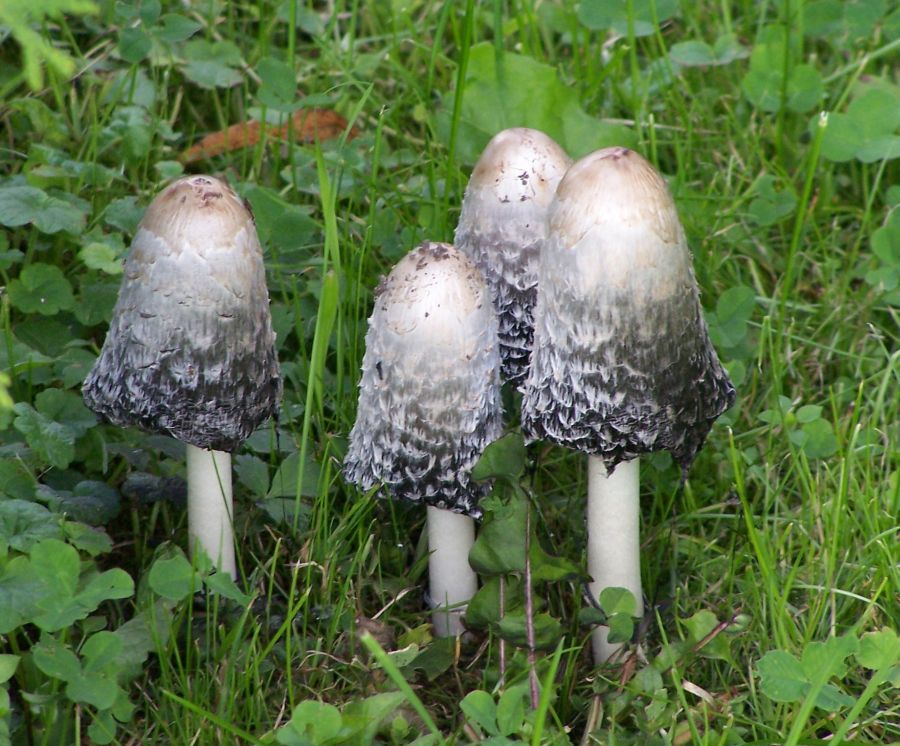
| Inky cap (Coprinus species) | Tall, narrow caps that melt into black liquid within a day or so | Rich organic matter nearby |
| Puffball | Round white ball, usually an inch or less in lawns, filled with dark spores when mature | Decaying organic matter; harmless to grass |
| Stinkhorn | Finger-shaped stalk with slimy tip and a strong rotting smell | Decaying wood or mulch; attracts flies |
| Fairy ring mushroom (Marasmius oreades) | Small tan caps in circles or arcs | Fairy ring fungus spreading through soil and thatch |
| Meadow mushroom (Agaricus campestris) | Whitish cap, often in grassy areas | Common in grassy areas; can form rings |
| Green-spored parasol (Chlorophyllum molybdites) | Large white to tan scaly cap, ring on stem, gills turning greenish | Poisonous; common in Southern lawns |
| Haymaker’s mushroom (Panaeolus foenisecii) | Small brown cone-shaped caps on slender stems | Frequent watering, often in new sod |
| Honey mushroom (Armillaria mellea) | Honey-colored clusters at tree bases in fall | Tree root disease; call an arborist |
| Bird’s nest fungus | Tiny cups holding egg-like spore packets | Harmless curiosity |
This table is a starting point, not a field guide. UC IPM is blunt that there are no simple tests to tell poisonous mushrooms from edible ones, and only an expert can do it reliably.
Are Lawn Mushrooms Poisonous?
Some are, and you usually can’t tell which by looking. Treat every lawn mushroom as poisonous unless an expert has identified it.
The one homeowners most often meet is the green-spored parasol. University of Florida IFAS Extension calls Chlorophyllum molybdites the most common cause of mushroom poisoning in the United States. It’s one of the largest and most common lawn mushrooms in the Southeast and often grows in fairy rings. UF/IFAS describes a large, scaly, white to brown cap from about 2 to 12 inches across, a ring on the stem, and gills that turn greenish as it matures, with a green spore print. Symptoms typically start 1 to 2 hours after eating it and include nausea, vomiting, and diarrhea. UF/IFAS notes it isn’t fatally poisonous like some species, but young children and dogs face higher risk because they’re smaller and more likely to eat mushrooms off the lawn, and there’s no known antidote.
If a child or pet may have eaten a lawn mushroom, contact a poison control center, your doctor, or your veterinarian right away, and bring a sample of the mushroom if you can. Our removal guide, linked below, covers dog safety in more detail.
Slime Molds and Other Lookalikes
Not everything that pops up overnight is a mushroom. UC IPM describes slime molds as primitive organisms, not true fungi, that grow in the same damp conditions. The common species, Fuligo septica, forms a yellow mass that can look like something a dog threw up on the lawn. It usually dries into a dusty crust and disappears within about a week. UC IPM says you can rake it, mow it, or hose it off.
Should I Get Rid of Mushrooms Growing in My Yard?
You don’t have to. Iowa State says most lawn mushrooms cause no damage to the grass, soil, or nearby plants, so no action is required. Missouri Botanical Garden agrees they’re not harmful to the lawn and will disappear on their own as they age.
Remove them when:
- Children or pets use the yard. UC IPM lists this as the main reason to pick them.
- They’re honey mushrooms at a tree base. The tree needs attention.
- A fairy ring is killing grass. That’s a lawn problem, not just a cosmetic one.
- You don’t like how they look. Fair enough.
Leave them if none of those apply. They’re breaking down dead material and feeding your soil.
How to Get Rid of Mushrooms: The Short Version
You can knock the mushrooms down in minutes, but making them stop coming back means removing what they’re eating or drying out the spot.
- Pick, rake, or mow them off as soon as they appear. UC IPM notes this may limit spore spread, though spores blow in from neighboring yards anyway.
- Cut back watering if you irrigate, and fix spots that stay soggy.
- Dig out buried wood or old roots where mushrooms keep coming back in the same spot.
- Thin thatch and aerate compacted or poorly drained areas.
- Speed up decomposition with nitrogen. UC IPM says applying readily available nitrogen at 1 pound of actual nitrogen per 1,000 square feet, such as 5 pounds of ammonium sulfate (21-0-0), can hasten breakdown of the organic matter feeding them.
- Wait it out. Iowa State notes they disappear permanently once the organic matter is used up, though they may return for several years before then.
Iowa State is also clear that nothing applied to the ground will prevent mushrooms from coming up, so skip the sprays. For a full rundown of what works and what doesn’t, see how to get rid of mushrooms in your lawn.
If compaction and standing water are keeping your lawn soggy, core aeration helps water soak in. On LawnGuru, aeration averages $123, with most jobs between $74 and $193. Get lawn aeration quotes through LawnGuru and compare local providers.
Frequently Asked Questions
How can I get rid of fungi in my lawn?
You can’t, and you don’t want to. Fungi are a normal, beneficial part of healthy soil. What you can control is the mushrooms they produce: remove buried wood and roots, cut back on watering, improve drainage, and thin heavy thatch.
What are these large white mushrooms in my yard?
Several large white mushrooms show up in lawns, including meadow mushrooms and large puffballs. In the South, a big white to tan scaly cap with a ring on the stem and greenish gills may be the green-spored parasol, the most common cause of mushroom poisoning in the U.S. Don’t touch or eat it, and keep kids and pets away until it’s removed.
What are some common mushrooms found in the garden?
In lawns and garden beds, the most common are inky caps, puffballs, stinkhorns, fairy ring mushrooms, meadow mushrooms, haymaker’s mushrooms in new sod, and bird’s nest fungi. Iowa State notes they’re all managed the same way.
Do mushrooms mean my soil is healthy?
Usually, yes. They mean there’s organic matter in the soil and fungi breaking it down into nutrients. The exception is honey mushroom clusters at the base of a tree, which can signal root disease.
Will lawn mushrooms go away on their own?
Yes. Each mushroom collapses within days, and new ones stop when the weather turns warmer and drier. They disappear for good once the buried wood or roots feeding them have rotted away, which can take several years.
Can mushrooms spread from my neighbor’s yard?
Spores do travel. UC IPM notes most spores are windblown over long distances, so picking your mushrooms won’t keep new fungi out. Whether they fruit in your lawn depends on whether there’s food and moisture for them.