
Quick Answer: Florida spans USDA Plant Hardiness Zones 8b to 11b, the widest range of any single state. The Panhandle around Pensacola sits in zone 8b, with winter lows down to 15°F. The Florida Keys sit in zone 11b, where it almost never freezes at all. Most of the state falls somewhere in between: zones 9a and 9b across North Florida, 9b to 10a through Central Florida, and 10b to 11a across South Florida’s mainland.
Search “what planting zones are in Florida” and you’ll get answers that assume you live in Orlando. That’s a problem if you’re gardening in Pensacola, where winter lows can hit 15°F, or in Key West, where frost basically doesn’t happen. Florida isn’t one climate. It’s four or five, stacked north to south, and the zone map is the tool that tells you which one you’re actually standing in.
What Are USDA Plant Hardiness Zones?
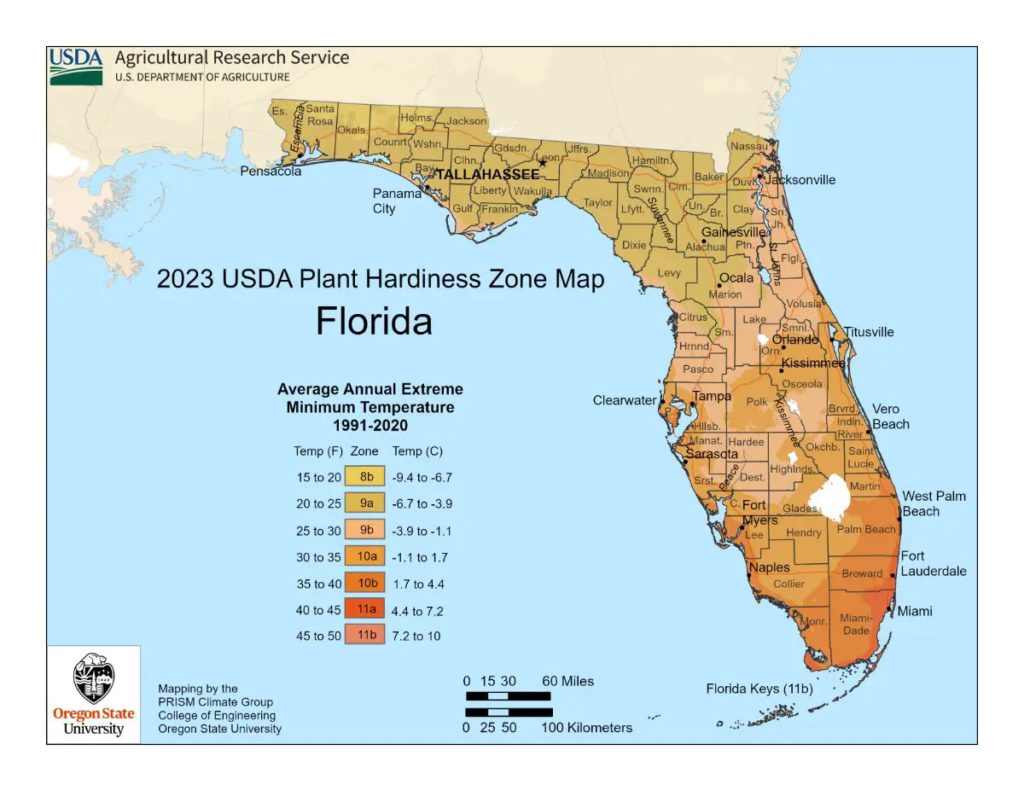
The USDA Plant Hardiness Zone Map divides the country into bands based on the average coldest night your area sees in a typical winter. Each full zone covers a 10-degree range, split into “a” (colder) and “b” (warmer) half-zones five degrees apart. Zone 9a runs 20°F to 25°F; zone 9b runs 25°F to 30°F. The number tells you nothing about heat, rainfall, or soil. It only tells you how cold your coldest night usually gets, which is exactly the information a perennial, tree, or shrub needs to survive.
The USDA’s Agricultural Research Service updated the map in 2023 using 1991 to 2020 climate data, replacing the older map built on 1976 to 2005 data. Much of Florida shifted about half a zone warmer as a result. If the plant tag on something you bought years ago still says “zone 9,” it’s worth rechecking your current zone before assuming that’s still accurate.
Florida’s Planting Zones at a Glance
| Zone | Winter Low | Roughly Where |
|---|---|---|
| 8b | 15°F to 20°F | Panhandle counties near the Alabama border |
| 9a | 20°F to 25°F | Inland North Florida, including Tallahassee and Gainesville |
| 9b | 25°F to 30°F | Coastal North Florida into parts of Central Florida, including Jacksonville |
| 10a | 30°F to 35°F | Most of Central Florida, including Orlando and Tampa |
| 10b | 35°F to 40°F | Southwest coast and parts of the southeast, including Fort Myers |
| 11a | 40°F to 45°F | Southeast coast, including Miami and Fort Lauderdale |
| 11b | 45°F to 50°F | The Florida Keys only |
Seven zones in one state is unusual. Most states span two or three. Florida’s length, nearly 450 miles from the Alabama border to Key West, plus the moderating effect of ocean on three sides, is what stretches the range that wide.
How UF/IFAS Splits North, Central, and South Florida
Most articles on this topic wave at “North Florida” and “South Florida” without saying where one ends and the other begins. University of Florida IFAS Extension draws the lines using two specific highways: North Florida is everything north of State Road 40, Central Florida sits between State Road 40 and State Road 70, and South Florida is everything south of State Road 70. State Road 40 runs roughly through Ocala. State Road 70 runs roughly through Sarasota and Okeechobee. That’s a real, checkable boundary, not a fuzzy regional label.
Under that split, North Florida covers USDA zones 8 and 9. Central Florida covers zones 9 and 10. South Florida covers zones 10 and 11. The zone numbers overlap across the boundaries because climate doesn’t change at a highway; it shifts gradually, which is also why a single Florida county can straddle two half-zones.
North Florida: Zones 8b to 9b
This is the only part of Florida that gets genuinely cold winters. Zone 8b sits in a narrow strip of Panhandle counties, Escambia, Santa Rosa, Okaloosa, Walton, and Holmes, bordering Alabama, where lows can reach 15°F. Most of the rest of North Florida, including Tallahassee, Gainesville, and Pensacola, falls in zone 9a. Coastal areas and the stretch toward Jacksonville warm slightly into 9b.
North Florida gets a real dormant season. Frost is common enough that citrus and other frost-sensitive plants need protection most winters, not just in a rare cold snap. It’s also the one part of the state where cool-season vegetables like broccoli and cabbage genuinely thrive without needing to be planted in the dead of winter to dodge summer heat.
Central Florida: Zones 9b to 10a
Central Florida is where most of the state’s population actually lives, Orlando, Tampa, Ocala’s southern edge, and the Interstate 4 corridor between them. Zone 9b handles the northern edge of this band, and 10a covers the rest, including Orlando and Tampa proper. Winter lows here run 25°F to 35°F.
The defining trait of Central Florida’s climate isn’t the cold, it’s the inconsistency. Some winters pass without a single hard freeze. Others bring a night or two cold enough to damage tropical plants that survived fine the year before. That unpredictability is why frost protection gear, not just frost-tolerant plant choices, matters more here than it does further south.
South Florida and the Keys: Zones 10b to 11b
South of roughly Sarasota and Okeechobee, winter stops being a real threat. Zone 10b covers the southwest coast around Fort Myers and parts of the southeast; 11a covers Miami and Fort Lauderdale; 11b belongs entirely to the Florida Keys, where frost essentially never happens. Winter lows across this band run from 35°F up past 50°F.
This is the only part of the continental United States where true tropical plants, mangoes, coconut palms, bananas, can be planted with almost no winter risk. It’s also warm enough that “growing season” stops being a meaningful phrase. Most of South Florida grows something year-round.
What Your Zone Changes About What You Plant
Knowing your zone matters most for perennials, trees, and shrubs, plants you expect to survive multiple winters. It matters far less for annuals, since those complete their life cycle in a single season regardless of zone. A tomato plant doesn’t care what zone it’s in; it cares whether it’s warm enough right now.
Where zone really earns its keep is with woody and perennial landscape plants. A citrus tree that thrives unprotected in zone 10a can get knocked back to the ground by a single 9a winter. Bougainvillea grown as a permanent shrub in Miami has to be treated as an annual, or heavily protected, in Tallahassee. If you’re deciding what to put in the ground long-term, our guide to the best plants for Florida landscaping and our roundup of native Florida plants both organize choices with this kind of zone variation in mind, rather than assuming one plant list works statewide.
Lawn grass follows a different rule entirely. Nearly every common Florida lawn, St. Augustine, Bahia, Bermuda, Zoysia, is a warm-season grass suited to the whole state’s zone range; the differences that matter for grass are soil type, salt exposure, and shade, not winter cold. Our breakdown of Florida grass types and best grass seed for Florida by region cover that soil-and-region logic in full.
Finding Your Exact Zone
The zone map above gives you the state-level picture, but zones can shift within a single county, and even within a single city, depending on elevation and how much pavement surrounds a property. The fastest way to confirm your specific zone is the USDA’s ZIP code lookup tool, which returns your exact zone in seconds.
Worth knowing: urban areas with more concrete and asphalt sometimes register a half-zone warmer than nearby rural land, an effect known as the urban heat island. A ZIP code in downtown Tampa and one in the surrounding countryside can technically fall into different half-zones despite being a short drive apart. If a plant tag says your zone is borderline, that local variation is often why.
FAQ
What are the different planting zones in Florida?
Florida spans USDA zones 8b through 11b: 8b in the far western Panhandle, 9a and 9b across North Florida, 9b to 10a through Central Florida, 10b and 11a across South Florida’s mainland, and 11b reserved for the Florida Keys.
Where is zone 9 and zone 10 in Florida?
Zone 9 covers most of North Florida and stretches into northern parts of Central Florida, including Gainesville, Tallahassee, and Jacksonville. Zone 10 covers most of Central Florida and parts of South Florida, including Orlando, Tampa, and Fort Myers.
What part of Florida is zone 10?
Zone 10a covers most of Central Florida, including Orlando and Tampa. Zone 10b picks up in South Florida along the southwest coast around Fort Myers and parts of the southeast coast.
Is Florida in one hardiness zone or several?
Several. Florida spans seven half-zones, from 8b to 11b, which is unusually wide for a single state. Most states cover two or three zones total.
Does my zone tell me when to plant vegetables?
Not directly. Hardiness zone tells you what perennials can survive winter where you live; it doesn’t set vegetable planting dates, which follow your local frost dates and growing season length instead. North Florida has a real frost season and a narrower vegetable planting window than Central or South Florida, where planting calendars run almost year-round.