
Quick Answer: Georgia spans USDA Plant Hardiness Zones 6b to 9a on the current 2023 map. North Georgia’s mountains sit in 6b to 7a, the Atlanta Piedmont and central Georgia fall mostly in 8a to 8b, and coastal Georgia reaches 8b to 9a. If you’ve seen a different range somewhere online, it’s likely pulling from the older 2012 map. The USDA updated the map in November 2023, and most of Georgia shifted a half zone warmer.
Search this question and you’ll find at least three different answers: 7a to 9a, 6a to 9a, 7a to 9b. They’re not all wrong exactly, they’re just not all using the same map. The USDA revised its Plant Hardiness Zone map in November 2023, and a lot of gardening content online, including some still-active competitor pages, hasn’t caught up.
Georgia’s Current USDA Planting Zones
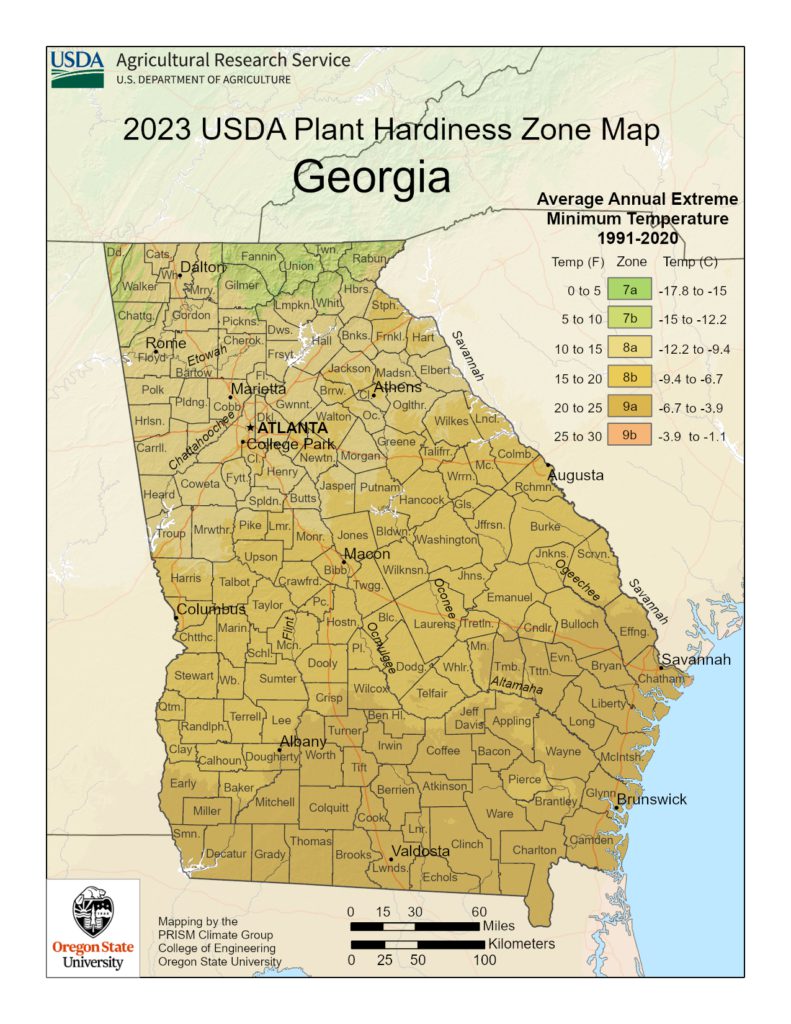
On the 2023 USDA Plant Hardiness Zone Map, Georgia runs from zone 6b in the far northern mountains to zone 9a along the coast. That’s a wider range than the “7a to 8a” figure still floating around from the 2012 map, and it reflects real regional variation, not just measurement noise. A zone number is based on the average coldest temperature a location hits in a typical winter, so a half-zone difference is the difference between which camellia cultivars survive your yard and which ones don’t.
| Region | Zone (2023 Map) | Average Winter Low |
|---|---|---|
| North Georgia mountains | 6b to 7a | -5°F to 5°F |
| Atlanta and the Piedmont | 8a to 8b | 10°F to 20°F |
| Central and South Georgia | 8a to 8b | 10°F to 20°F |
| Coastal Georgia | 8b to 9a | 15°F to 25°F |
Why the Zones Changed in 2023
The short version: the map got recalculated with newer weather data, and winters got measurably milder in most of the state.
The 2012 map was built from 1976 to 2005 temperature records. The 2023 map uses 1991 to 2020, a more recent 30-year window, and it shows more than half of the Southeast shifting a half zone warmer, according to UGA Extension’s climate program. In the Atlanta area specifically, Fulton, Cobb, Forsyth, and Cherokee counties moved from zone 7b to zone 8, according to UGA Extension’s Fulton County office. That’s not a rounding difference. It changes which plants a garden center will sell you as “hardy” for your area.
North Georgia: Zones 6b to 7a
The Blue Ridge, Appalachian Plateau, and Ridge and Valley regions make up North Georgia, and they’re the coldest part of the state by a wide margin. Higher elevation means real winter cold, occasional hard freezes, and a shorter growing season than the rest of Georgia gets. Frost typically hits by mid-October and lingers into April in the highest valleys.
Turf-type tall fescue does best here since North Georgia sits in the transition zone, cool and warm enough for both cool-season and warm-season grasses to survive, though fescue is the more reliable long-term choice at this elevation. Bermudagrass and Zoysiagrass can work in the warmer pockets but push their cold tolerance at the upper elevations.
Atlanta and the Piedmont: Zones 8a to 8b
This is the zone that changed the most in 2023, and it’s also where most of Georgia’s population lives. Atlanta, Marietta, Athens, and the surrounding Piedmont counties sit mostly in zone 8a to 8b now, up from the 7b most of this area carried on the old map. Average lows run 10°F to 20°F, last frost falls around late March, and the frost-free season runs roughly 220 to 230 days.
That extra half zone opens the door to plants that would have struggled here a decade ago, but it also means a plant tag reading “hardy to zone 7” is now giving you a bigger safety margin than it used to, not a tighter one. Zoysiagrass and Bermudagrass both perform well through this zone; tall fescue still works but needs more summer irrigation than it did further north.
Central and South Georgia: Zones 8a to 8b
Macon, Valdosta, Dublin, and the rest of the Fall Line and inland Coastal Plain fall in the same 8a to 8b range as metro Atlanta, though summers run hotter and drier here. Warm-season grasses are the clear choice: Zoysiagrass, Bermudagrass, and Centipedegrass all hold up to the heat better than anything cool-season.
Coastal Georgia: Zones 8b to 9a
Savannah, Brunswick, and the barrier islands are Georgia’s mildest climate, reaching zone 9a right along the coast. Frosts arrive late, usually not until late November, and some immediate coastal spots go entire mild years without a hard freeze at all. That long frost-free window, close to 260 days in Savannah, supports subtropical ornamentals that won’t survive anywhere else in the state.
The Real Risk of Planting at the Edge of Your Zone
A zone number tells you what a plant can typically survive, not what it will survive every single year, and Georgia’s own recent history makes that distinction matter. A UGA Extension master gardener in Fulton County lost 35 Indian hawthorn shrubs, plants rated hardy to zone 8 that had survived nine mild winters without issue, when a December 2022 cold snap dropped to 6°F, a low the area hadn’t seen in 30 years. The shrubs were exactly matched to their zone. They died anyway, because a zone rating describes an average, not a guarantee against outliers.
The practical takeaway from that experience: if you’re gardening near the edge of your zone (zone 8 in a spot that recently shifted from 7b, for example), lean toward the more cold-hardy cultivar rather than the one rated for the exact zone you’re in. For gardenias and camellias specifically, cultivars like Frostproof and Foolproof are bred for an extra margin of cold tolerance and are worth the trade-off over a standard zone 8 variety.
Best Grass by Zone in Georgia
Grass selection follows the same north-to-south split as everything else in this article, cooler and mixed in the mountains, warm-season everywhere else. Our guides on the best grass types for a Georgia lawn and the full rundown of grass types grown across the state break this down by species and region in more depth than fits here, and our warm-season versus cool-season guide covers the growth-cycle differences behind why some grasses only work in certain zones at all. If you want the mechanics of what a hardiness zone actually measures and how the USDA builds the map, our explainer on USDA hardiness zones covers that separately from this state-specific breakdown.
FAQ
Where is zone 8 in Georgia?
Zone 8 covers most of the state outside the North Georgia mountains, including metro Atlanta (8a to 8b), the Piedmont, and central Georgia down through Macon and Valdosta. It’s the most common zone in Georgia by land area.
Is Atlanta zone 7 or 8?
Zone 8 as of the 2023 USDA map. Most of the metro area, including Fulton, Cobb, Forsyth, and Cherokee counties, was reclassified from 7b to 8a or 8b in the November 2023 update. Older sources still listing Atlanta as zone 7b are working from the outdated 2012 map.
What is my growing zone in Georgia?
It depends on where in the state you are: roughly 6b to 7a in the North Georgia mountains, 8a to 8b through the Atlanta Piedmont and central Georgia, and 8b to 9a along the coast. For an exact answer, enter your zip code at the USDA’s own Plant Hardiness Zone Map tool, which pulls the current 2023 data directly.
What can I plant in Georgia right now?
That depends on the season more than the zone, since Georgia’s long growing season supports something in nearly every month. Check your region’s frost dates before setting out anything tender: Atlanta’s last spring frost falls around late March, Macon’s around early April, and Savannah’s as early as late February or early March.
Whether you’re planting new grass, dealing with dead patches from a cold snap, or just want a lawn that matches your zone’s actual climate, LawnGuru connects you with local Georgia lawn and landscaping pros who already know which cultivars hold up in your specific region.